
Certificate Course on Muslim Personal Laws
About the Certificate Course
Introduction
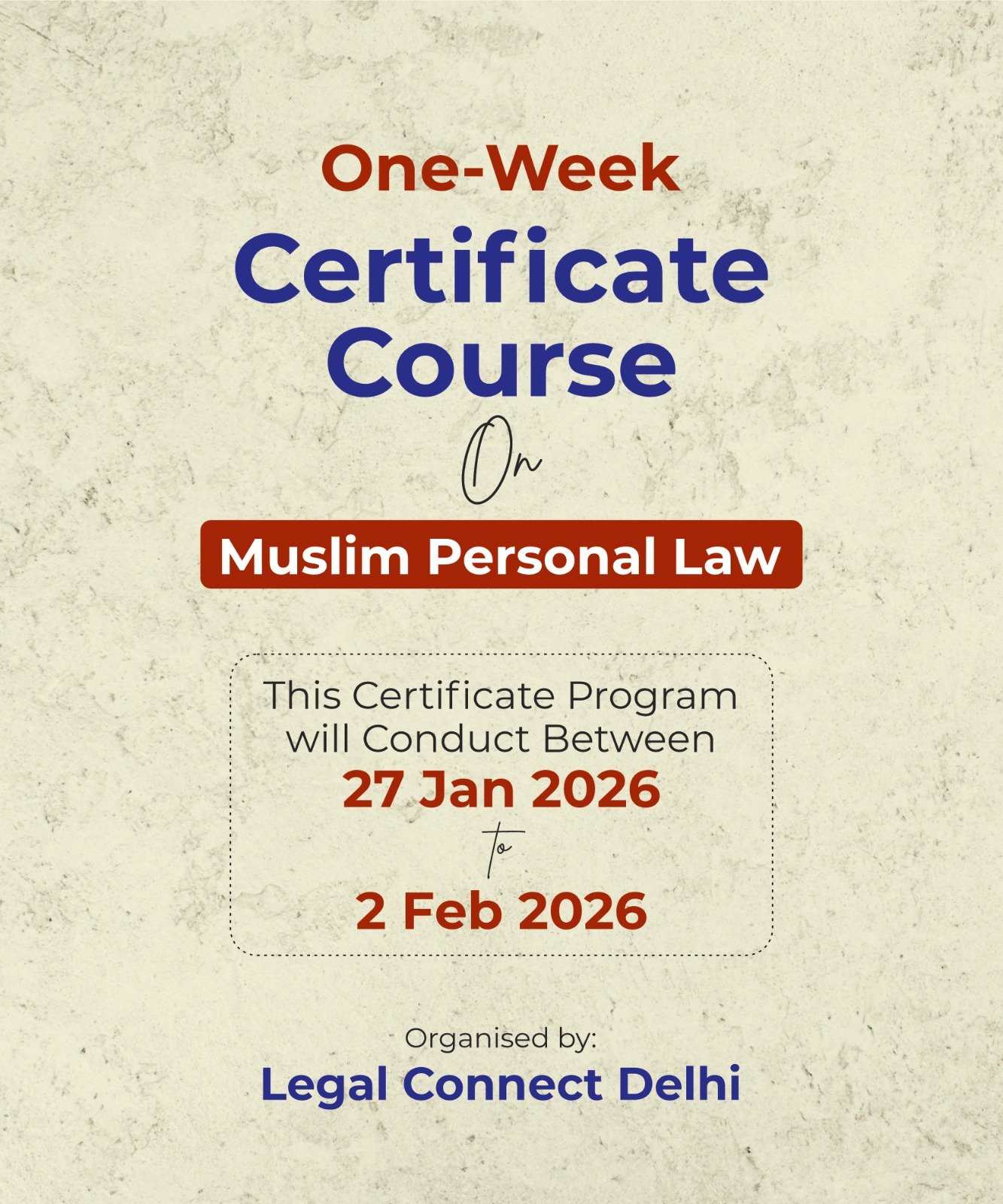
Legal Connect Delhi proposes to conduct a One-Week Certificate Course on Muslim Personal Law for law students, researchers, advocates, judicial aspirants, academicians, and all interested learners.
India is a diverse nation where personal laws play an essential role in social regulation. Muslim Personal Law, in particular, is currently receiving wide judicial and academic attention. Many concepts relating to marriage, divorce, inheritance, maintenance, and guardianship are being analysed by the Supreme Court of India and various High Courts.
The objective of this course is to provide a comprehensive, research-based and jurisprudential understanding of Muslim Personal Laws through lectures by eminent scholars, legal experts, jurists and academicians.
2. Rationale of the Programme
This certificate course is necessary because:
- Several provisions of Muslim Personal Law are currently under legal scrutiny and debate.
- Lack of structured legal training on Islamic jurisprudence is creating confusion among law students and young practitioners.
- Courts, media, policymakers and the public often misunderstand personal laws due to limited authentic sources and lack of awareness.
- Lawyers
require clarity to handle matrimonial, property and maintenance cases involving Muslims.
This course intends to bridge the gap between classical Islamic legal sources and modern Indian legal system.
Course Objectives
01
To provide a clear and structured understanding of Muslim Personal Law by studying its sources, principles, and practical application within the Indian legal framework.
02
To equip participants with legal and jurisprudential knowledge required for dealing with matrimonial, inheritance, maintenance, custody, and property-related disputes involving Muslims.
03
To bridge the gap between classical Islamic jurisprudence and modern court practices, enabling students and professionals to understand judicial interpretations, evolving case laws, and constitutional challenges.
04
To develop research, drafting, and advocacy skills necessary for handling personal law matters before courts, tribunals, mediation forums, and legal aid platforms.
05
To promote informed, responsible, and research-based legal awareness so participants can contribute to academic discussion, legal reforms, and community-level dispute resolution with confidence and clarity.
Key Topics Covered
Topic 1 — Foundations of Muslim Personal Law
- Sources of Muslim Personal Law
- Nature, scope and application of Shariah in India
- Relationship between personal laws and statutory laws
Topic 2 — Marriage (Nikah) & Related Rights
- Concept and essentials of Nikah
- Legal validity and enforceability of marriage
- Mehr: Types, rights and enforcement
- Rights and duties of husband and wife
Topic 3 — Dissolution of Marriage & Post-Marital Rights
- Forms of divorce: Talaq-e-Ahsan, Talaq-e-Hasan, Talaq-e-Bain
- Khula, Tafweez, Mubarat
- Faskh-e-Nikah (Judicial separation) — role of courts
- Maintenance & alimony (wife, children & parents)
- Custody & guardianship of children (Hizanat & Wilayat)
Topic 4 — Inheritance, Property & Financial Rights
- Principles of inheritance (Faraiz)
- Shares of legal heirs — practical case studies
- Wills (Wasiyyat) and Gift (Hiba)
- Partition and succession under Muslim Law
- Muslim Women (Protection of Rights on Marriage) Act, 2019 — legal implications
Topic 5 — Emerging Personal Law Challenges in Courts
- Uniform
Civil Code (UCC) — legal & constitutional debates
- Triple
Talaq Judgement (Shayara Bano v. Union of India)
- Maintenance
disputes: CrPC 125 (144 of BNSS) vs Muslim Women Act
- Live-in
relationships, interfaith marriages & conversion issues
Topic 6 — Modern Social & Biotechnological Issues
- Surrogacy
under Muslim law
- Adoption
& foster care
- Child
rights and welfare in the context of Islamic jurisprudence
Topic 7 — Dispute Resolution & Constitutional Interface
- Personal
laws vis-à-vis fundamental rights (Articles 25–26, 29–30)
- Role of
Darul Qaza, mediation & ADR in matrimonial disputes
- Uniform
Civil Code (UCC) — legal & constitutional debates
Duration
- One Week (7 Days)
- Daily online lectures (1.5 to 2 hours per day)
- Interactive sessions and Q&A at the end of each lecture.
Eligibility
- Law Students (3-year or 5-year courses)
- Law Graduates
- Advocates and Academicians, Law Professors & anyone interested in Islamic Law,
- Islamic Jurists & Scholars of Fiqh
- Family Court Counsellors & Mediation Specilists
Certification
- Upon successful completion of the course, participants will be awarded a Certificate of Completion by Legal Connect Delhi.
Proposed Dates
- Applications Open: 25th Dec. 2025
- Application Deadline: 25th January 2026
- Course will Start on: 27th January till 02th June 2026